
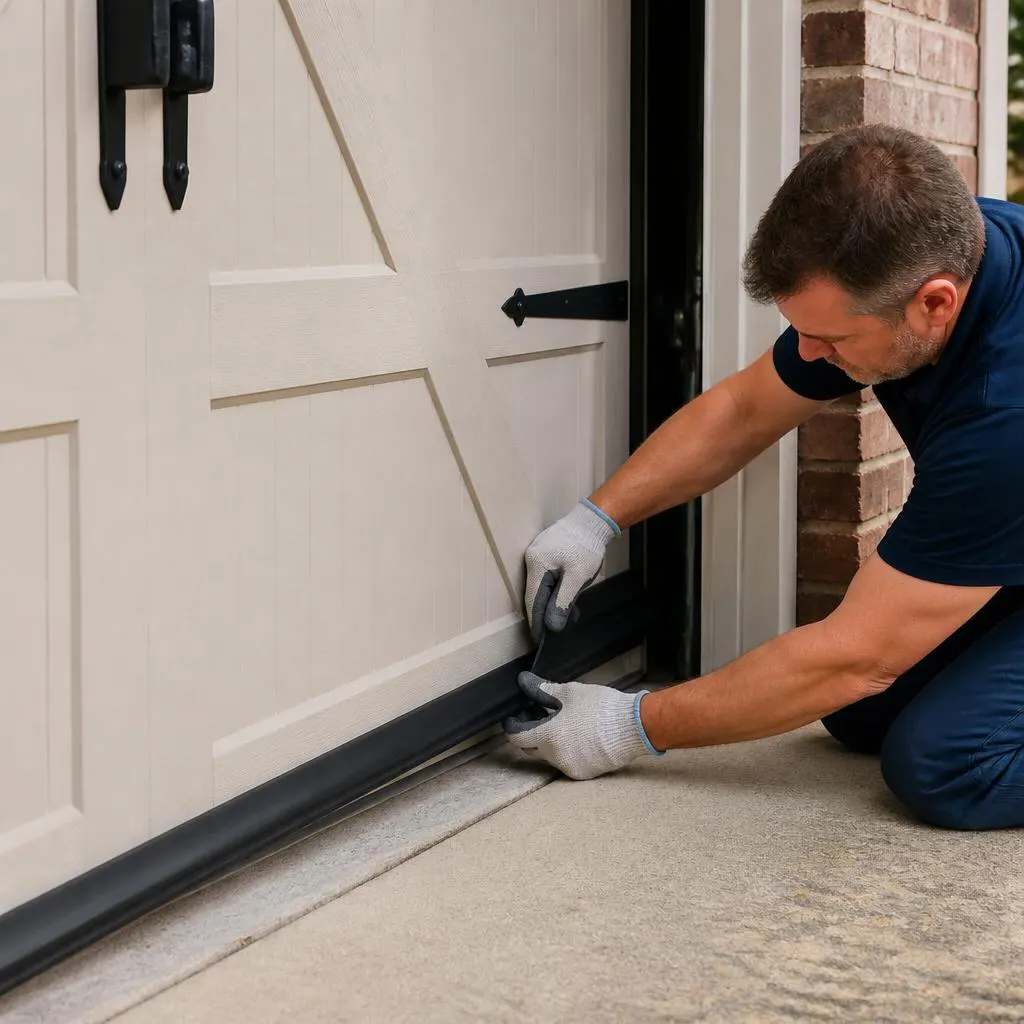
Leave a dent alone through one more Illinois winter and here's what actually happens: moisture works into the crease, road salt spray from the driveway finds the broken paint, and by spring that "cosmetic" ding has a rust ring growing out of it. If the dent is also pinching the track or the panel seam, every freeze-thaw cycle flexes that weak spot a little more. What costs nothing to inspect this week can turn into a cracked panel or a jammed door by the time spring storms roll through. So before this becomes a bigger argument than it needs to be, here's how to tell which kind of dent you're actually dealing with.
The argument, settled with one question
It's never really "is the dent ugly" — it's "does the dent matter." A dent matters if it changes how the door moves, seals, or holds its shape under load. A dent doesn't matter (yet) if the door still opens and closes smoothly, closes flush with an even gap all the way across the bottom, and the metal springs back when you press on it rather than staying creased.
Dents that are cosmetic only
These are the ones you can genuinely ignore or fix purely for looks:
- Small dings in the middle of a raised panel, away from the edges, hinges, and track
- Shallow impressions where the metal rebounded instead of creasing
- Dents that don't change how the door closes — no new gap, no new light leak, no scraping
On steel doors, these can often be pulled out with a suction-cup panel puller and touched up with exterior-grade filler and matching paint. On wood doors, wood filler, sanding, and paint do the same job. Neither repair affects how the door operates — it's purely a looks call, which means it's fine to skip for now if nobody's bothered enough to spend a Saturday on it.
Dents that affect function (fixable, but don't wait)
These dents still allow a repair instead of a full panel swap, but they're actively causing a problem:
- Dents along the vertical edge where the panel rides in the track — these cause the rollers to bind, the door to scrape metal-on-metal, or the opener to strain and reverse mid-cycle
- Dents near a hinge mounting point that have pulled a hinge slightly out of true, causing uneven closing or a panel that sits proud of its neighbors
- Dents that create a gap at the bottom or sides when the door is fully closed — this is the one to take seriously before winter, since any gap lets in cold air, wind-driven snow, and moisture that then freezes along the weatherstrip
These usually need more than a filler kit: realigning or replacing a hinge, re-seating rollers, or swapping a single panel section if the local hardware store or manufacturer stocks a matching one. It's a repair, not a full replacement, but it's not a weekend DIY project if the track alignment is off — a misaligned door under spring load (high winds, a kid leaning on the opener button repeatedly) can pop off the track entirely.
When a dent is structural
This is the category that ends the debate in favor of "we need a new door," or at minimum a new section:
- A dent that has bent the vertical stile — the structural rail that runs up the edge of each section and carries the hinges and rollers. If that's bent, the whole section flexes wrong even after you "fix" the dent's appearance.
- A crease sharp enough that the metal has work-hardened and cracked at a seam — once steel creases like that, it's permanently weaker at that point, not just dented.
- Impact damage — someone backed into the door, a branch came down in a storm, a wind gust slammed it — that bent a strut, pushed a panel out of its frame, or pulled a cable drum off-center.
- A dent big enough that the panel visibly bows when the door is under tension (partway up or down), rather than sitting flat.
Structural damage isn't about appearance anymore — it's about whether the door can safely hold the spring tension and wind load it's built for. Given how much wind load matters here during spring storm season, a structurally compromised panel isn't something to gamble on for a summer.
A quick test before you call anyone
- Disconnect the opener and move the door by hand (if it's safe and balanced) or just run it slowly on the opener, listening for new grinding or catching.
- Check the gap along the bottom and sides with the door fully closed — it should be even all the way across.
- Press on the dent. Springs back = cosmetic. Stays creased or has a visible crack at the edge = functional or structural.
- Look at the vertical edges near the dent for any bend in the track-side rail, not just the panel face.
When to call Romeoville Garage Door Service
If the dent is anywhere near a hinge, track, or corner, or if you've noticed new noise, drag, or a gap since the impact happened, that's the point to stop guessing. We'll check alignment, roller condition, and panel integrity as part of a standard Garage Door Repair visit, and if the stile or a strut is bent, we'll tell you honestly whether a single-panel swap will hold up or whether a full Garage Door Installation makes more sense long-term — especially on an older door where a matching panel is hard to source. Either way, you'll know before winter whether that dent is a cosmetic annoyance or a problem that's going to get worse with every freeze-thaw cycle.
If you're in Romeoville, Bolingbrook, Lockport, Plainfield, Joliet, Lemont, Naperville, or Woodridge and you've got a dent you can't quite agree about, give Romeoville Garage Door Service a call — we'll settle it for you.